
Were you a smart kid at school, the sort teachers said was intelligent and thoughtful? Maybe everyone said you’d go on to have a high-flying career because you shone so brightly.
But life doesn’t always follow a straight line.
If you experienced trauma at any point in your childhood, it might’ve interrupted that path. Perhaps people called you lazy or unmotivated in the past, and you started believing them at some point.
Here’s the reality, though. You aren’t lazy. You’re exhausted because your biology is working overtime to protect you.
Childhood trauma makes it harder to do well at work or school because it makes your brain prioritise safety above everything else. But eventually, once you stop feeling responsible for something beyond your control, you can start seeing yourself as worthy of the enormous amount of effort it takes to heal.
Trauma and the ACEs
Before we look at your work life, it helps to put a name to what you experienced. Doctors and therapists use the term Adverse Childhood Experiences, or ACEs for short. These are stressful or traumatic events that happen before you turn 18. While people often assume this only means physical abuse, it actually covers a wide range of difficulties.
The most recent research highlights certain experiences that impact health later in life. These include:
- Abuse: This can be physical, psychological, emotional, or sexual mistreatment.
- Neglect: Feeling ignored, unimportant, or not having your basic needs met.
- Family conflict: Growing up in a house with frequent arguing, silence, tension, or domestic violence.
- Bullying: Experiencing severe or persistent bullying at school or in your neighbourhood.
- Financial hardship: Living in a home that struggled with money, debt, housing instability, or poverty.
- Family illness: Living with a family member who was struggling with physical illness, mental health issues, or addiction.
Essentially, if you spent a lot of your childhood feeling scared, stressed, unsafe, or on edge, your body will have adapted to survive that environment.
The physical connection between trauma and health
You might wonder why something that happened years ago matters now.
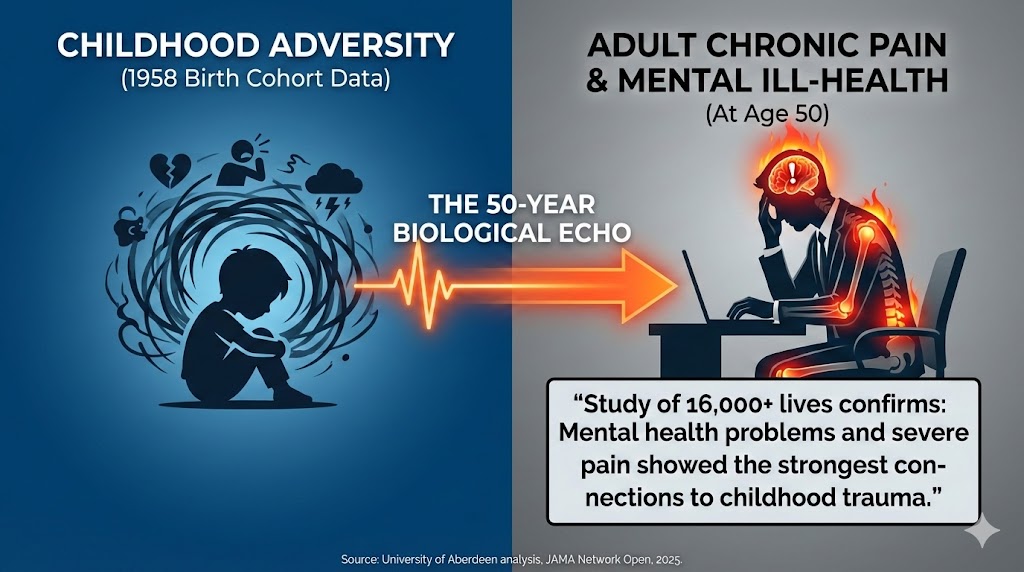
New research confirms that these experiences leave a lasting footprint on your health. A major study from the University of Aberdeen, published in 2025, looked at over 16,000 people to see how childhood trauma makes life harder for adults.
The findings were revealing.
Researchers discovered that adults who had difficult childhoods were significantly more likely to suffer from mental health struggles and severe chronic pain later in life. It challenges the old idea that you can miraculously pull yourself up by your bootstraps. The metabolic and immune systems appear to be particularly sensitive to the effects of ACEs.
So, if you often feel physically achy, exhausted, heavy, or anxious without a clear reason, it might not be random. Your nervous system is still reacting to the stress of the past.
7 Ways Trauma Makes it Harder to Do Well at Work or School
Here are seven ways a bad childhood might affect your adult life.
1. Hypervigilance: The scanner problem
Imagine your brain is a computer. When you sit down to write an email or finish a task, you probably think you’re using 100% of your power for that job.
However, a brain that’s experienced trauma works differently because it often gets stuck in a state of high alert. Deep down, a part of your brain called the amygdala acts like a security guard. It constantly scans the room for threats, looking for a frown on a boss’s face or listening to the tone of a voice. It’s even tracking the sound of footsteps in the hallway. Brain power is limited, so you only have so much battery life in a day. If your brain subconsciously uses 40% of its power to scan for danger, you only have 60% left for your actual work.
That means you feel shattered after doing the same amount of work as your colleagues because you’re essentially working two jobs. You have your career, and you have the full-time invisible job of keeping yourself safe. That fatigue you feel is the cost of running a high-intensity security program all day long.
2. Executive function: The manager goes offline
We often mistake knowing what to do with being able to do it. You might sit in front of a screen for hours knowing exactly what the task is and how to do it. Even though you want to do it and are desperate to start, you physically cannot make your hands start typing.
Doctors call this executive dysfunction.
Think of executive function as the manager in your brain who’s responsible for planning, prioritising, organising, and hitting the start button on tasks. When your nervous system detects stress, it sends blood flow away from that thinking part of the brain and rushes it toward your brain’s survival centers. In other words, your internal manager has left the building.
The result is task paralysis. You aren’t choosing to sit there, but rather you’re waiting for the biological signal to reconnect so you can function again. So, it’s not a willpower issue but a connection issue.
3. Window of Tolerance: A short fuse
Everyone has a window of tolerance, which is the zone where you can handle the ups and downs of the day without completely falling apart. If you’ve got a big window, it’s much easier to manage a bit of stress or deal with an annoyance and stay cool.
Trauma narrows this window. In turn, things that a colleague might shrug off like a printer jam or a schedule change can push you out of your zone instantly. You might feel a sudden spike of anxiety or anger, or on the other hand, you might go the other way and feel numb.
It often looks like a big reaction to a small problem. For example, you might feel like quitting over a small piece of feedback. It creates a fear that you’re difficult but in reality, your alarm system is just very sensitive. You’re operating with a hair-trigger because your body learned a long time ago that small shifts in the atmosphere could lead to danger.
4. Transference: Learning to trust authority again
Workplaces are built on hierarchies, but for some people with a history of trauma, people in power are figures of terror. If you had difficult experiences with parents or teachers in the past, your brain likely created a rule that says people in power are dangerous.
Now you walk into work and that rule applies to your manager. Without knowing, you may unconsciously project traits of people from your past onto your current boss. Experts call this transference.
For instance, a manager asking for a chat might sound like a neutral request to someone else, but to you, it sounds like a threat.
As a result, you might avoid speaking to management and be terrified to ask for help when you’re stuck. You might also hide mistakes because admitting a fault feels unsafe. These behaviors are natural and normal responses to adverse experiences, and you can overcome them. Learning to feel safe in your own body and mind, and to regulate difficult emotions, requires help from a professional and a lot of work on your end, but it’s absolutely possible.
See related post: Geniuses Who Failed School and Succeeded Anyway
5. The fawn response: Perfectionism as a shield
We usually hear about fight or flight responses, but there’s a third response that many smart people rely on called the fawn response.
Fawning is a survival strategy where you go to great lengths to avoid conflict. It’s like people-pleasing turned up to the maximum volume. The logic is that if you’re helpful and perfect, then you’re safe because no one hurts the person they need.
In a career, this looks like perfectionism. You feel unable to say no, so you take on massive workloads. You over-deliver on every single project to make sure you’re safe from criticism.
The result for most people pleasers is burnout. You might be a top performer right up until the day you collapse. Why? Because your performance was driven by fear rather than ambition, meaning you ran on adrenaline until the tank ran dry.
6. Hippocampal shutdown: Brain fog and memory
Have you ever read a paragraph five times and realised you still have no idea what it said? Or perhaps you walked out of a meeting and immediately forgot the instructions you were just given. Naturally, it makes you feel like you aren’t smart enough.
Biology, however, offers a different explanation. Chronic stress affects the hippocampus, which is the part of the brain responsible for learning and memory. Put simply, when your body floods with stress hormones, it struggles to record new information.
You feel like your hard drive is corrupted because you have to work three times as hard to remember the same information as your colleagues. But this isn’t a lack of intelligence. Your brain is prioritising immediate survival over learning new information. The intelligence is there, but the recording function is on pause. Finding self-guided ways to make sure your mind and body feel safe is the key to healing.
7. Dissociation: Feels like you’re floating away
Sometimes, when stress becomes too high, the brain pulls the emergency cord and uses dissociation to disconnect from reality to numb the pain or anxiety. This often happens during high-pressure moments like presentations or exams. You might feel floaty as if you’re watching yourself from above, or everything might suddenly feel unreal.
You might feel like colleagues are judging you because you miss information when you aren’t fully in the room.
Although losing time during the workday can be scary, it’s actually a brilliant biological defense mechanism designed to protect you. It just happens to be very inconvenient when you’re trying to work.
Honing your unique strengths despite adversity
Remember, you’re a biological system acting exactly as it was designed to act in dangerous conditions. The problem is that the danger has passed but your system hasn’t received the message yet.
That smart kid from school didn’t lose anything, they were just hiding behind a wall of armor they were forced to wear. You can teach your brain to feel safe again by widening your zone of coping and teaching your internal security guard to stand down.
Start by being kind to yourself. The exhaustion and the brain fog are injuries and not character flaws. You’ve survived 100% of your bad days, and that takes a level of resilience and intelligence that no exam can measure.
Want to read more? Learn about the best jobs for people who didn’t like school.
 Imogen Sharma
Leave a comment